

Document
Keynote Address by Mr. El-Ghassim Wane: “The Future of Peacekeeping: A Grim Picture?”
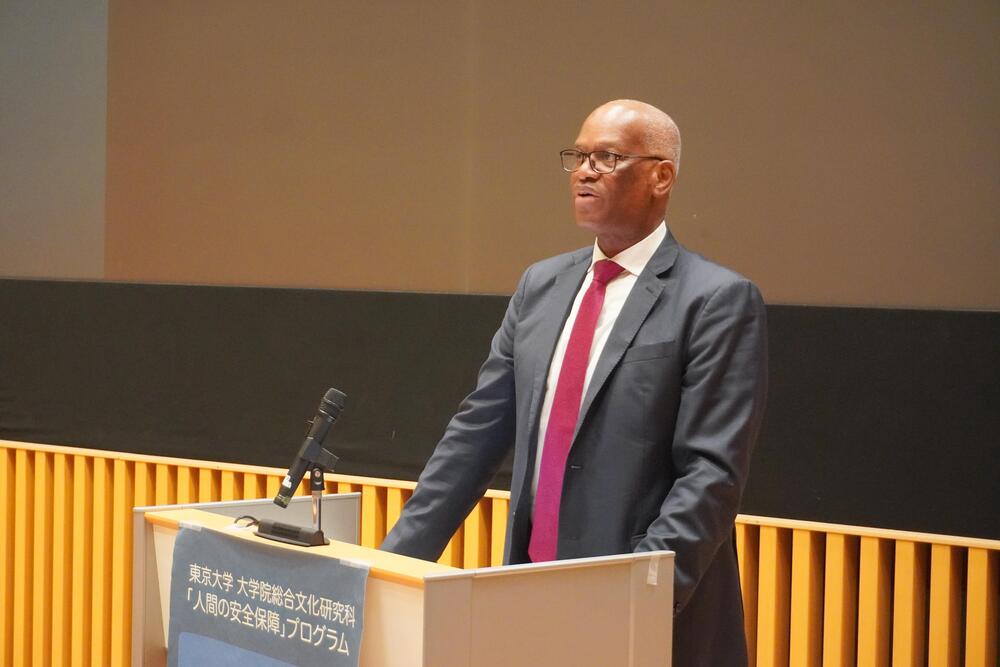
On 2 November 2026, the Graduate Program on Human Security (HSP) at the University of Tokyo and the Ministry of Foreign Affairs of Japan jointly hosted a special symposium on “Future of Peace Operations/Peace Interventions” at the University of Tokyo’s Komaba Campus.
We are pleased to share the full text of the keynote address delivered by Mr. El-Ghassim Wane,
former Special Representative of the Secretary-General in Mali and Head of the United
Nations Multidimensional Integrated Stabilization Mission in Mali (MINUSMA) and former Senior Official of the African Union, entitled “The Future of Peacekeeping: A Grim Picture?”
[Keynote Address by Mr. El-Ghassim Wane- “The Future of Peacekeeping- A Grim Picture?”.pdf]
The symposium also brought together Prof. Paul D. Williams, Prof. Ai Kihara-Hunt, and other experts and practitioners to discuss the future of peace operations.
The Future of Peacekeeping: A Grim Picture?
El-Ghassim Wane
Keynote Address at the Special Symposium on the Future of Peace Operations/Peace Interventions, Tokyo, 2 November 2026
It is a real pleasure to be back in Japan for the first time since 2002, nearly a quarter of a century ago.
My warm thanks to the University of Tokyo for inviting me to this Special Symposium on the Future of Peacekeeping and Peace Interventions.
Let me acknowledge Japan’s longstanding and multifaceted contribution to peacekeeping, as well as the presence here today of representatives of the Ministries of Foreign Affairs and Defense and of the Cabinet Office. Japan is one of the largest financial contributors to UN peacekeeping and has supported these efforts through personnel deployments, training and capacity-building. This sustained commitment makes Japan a particularly fitting place for a discussion about the future of peacekeeping.
I am also delighted to see Ai Kihara-Hunt, with whom I worked alongside Paul Williams on our 2024 Study on the Future of Peacekeeping, New Models, and Related Capabilities.
You may find this hard to believe: despite months of collaboration, this is the first time all three of us have been in the same room together. Throughout the Study, practical and scheduling constraints meant that two of us would meet in person while the third joined online!
We gather at a time of profound uncertainty in international affairs. As multilateral cooperation comes under increasing strain, the future of peacekeeping—one of the clearest expressions of collective international action—and its role in responding to conflict deserve particular attention.
I would like to approach this question in three steps.
First, I will examine the decline in the number and size of UN peacekeeping operations over the past decade, what this tells us about the international community’s response to conflict, and the political, operational and financial pressures facing the missions that remain.
Second, I will ask whether this is simply another cyclical downturn or whether the conditions that made the expansion of peacekeeping possible in the past have fundamentally changed. My own assessment is that we are experiencing deeper changes in the international system that make a return to earlier cycles of contraction and expansion far from assured.
Third, I will offer some suggestions on how peacekeeping can remain relevant in the period ahead, focusing particularly on the political dimensions. My conviction is that peacekeeping still has an important role to play, but that its future will depend on its ability to adapt to new realities. And the good news is that, difficult as the environment may be, such adaptation is possible.
This brings me to the central argument I would like to put before you.
Debates about the future of peacekeeping tend to focus on the challenges we confront most directly: personnel, capabilities, resources, mandates and operational effectiveness.
These are all important.
But they do not fully address the more fundamental question: Under what political conditions can peacekeeping be deployed, accepted and sustained in the first place? The future of peacekeeping will depend not only on its ability to adapt operationally, but also on how effectively all those involved in this enterprise can navigate the current challenges.
Let me begin, then, by looking at the evidence: How much peacekeeping has changed over the past decade, and what the figures tell us about the direction in which we are heading.
At the end of 2025, the United Nations had just over 48,000 uniformed personnel deployed across 11 peacekeeping operations, compared with approximately 107,000 personnel across 16 missions in 2015. The number of UN peacekeepers has therefore fallen by more than half, while the number of missions has declined by almost a third. And the contraction is set to continue: the United Nations Interim Force in Lebanon (UNIFIL) is scheduled to cease operations in December, with its personnel to be withdrawn in 2027, and just a few days ago, the Security Council failed to agree on the renewal of the mandate of the United Nations Mission for the Referendum in Western Sahara (MINURSO).
The broader picture is just as telling. According to the Stockholm International Peace Research Institute (SIPRI), there were 62 multilateral peace operations worldwide in 2016, deploying more than 153,000 international personnel. By the end of 2025, the number of operations had fallen to 58, while personnel numbers had dropped to fewer than 79,000 — a decline of 49 per cent.
Of course, these figures need to be interpreted with nuance. Côte d’Ivoire and Liberia are good examples. The missions deployed in these two countries (the United Nations Operation in Côte d’Ivoire — UNOCI and the United Nations Mission in Liberia — UNMIL) closed in 2017 and 2018, respectively, following significant progress towards peace and stability. Their closure was not a failure of peacekeeping; on the contrary, it reflected progress that the international community rightly welcomed.
However, successful closures are only part of the story. In recent years, several other missions have ended while the conflicts and security challenges they were deployed to address remained unresolved. Examples include Darfur in 2020, with the closure of the African Union-United Nations Hybrid Operation in Darfur (UNAMID), and Mali in 2023, with the withdrawal of MINUSMA at the request of the authorities. As noted earlier, the same trend is set to affect UNIFIL and now MINURSO.
And this retrenchment extends beyond peacekeeping: several special political missions, including most recently the United Nations Transitional Assistance Mission in Somalia (UNTMIS), have also been wound down, pointing to a broader contraction of the UN’s presence.
Since 2014, no new UN peacekeeping operation has been established. This is happening at a time when the world is experiencing the highest number of conflicts since 1945.
The contraction of UN peacekeeping has coincided with a shift towards other forms of international response. In Haiti, the Security Council authorized a multinational Gang Suppression Force supported by a UN office; in Gaza, it authorized an International Stabilization Force.
But the challenge goes beyond figures and the growing number of non-UN operations authorized by the Security Council. The missions that remain face growing political, operational and financial pressures.
First, Security Council unity is becoming harder to sustain. In 2025, four of the eight peacekeeping mandate renewals were adopted without unanimity. So far in 2026, two renewals have also been adopted without unanimity. These figures reflect divisions that can weaken the perception of a shared strategic vision.
Second, missions face growing constraints on their ability to implement their mandates. Restrictions on freedom of movement are a particularly clear example, increasingly addressed by the Security Council in mandate renewals and reporting requirements.
Third, the UN’s liquidity crisis, driven by delayed and unpaid contributions, is forcing cuts in expenditure and personnel, adding pressure on already overstretched missions.
Finally, many missions operate in protracted conflicts where political settlements remain elusive. Conflicts are becoming more complex, regional and international dynamics more entangled, and negotiated solutions harder to achieve.
Having looked at the current state of peacekeeping and the pressures facing the missions that remain, let me now turn to a broader question: Are we witnessing another cyclical downturn in peacekeeping, or a more lasting change in both the scale of its deployment and the political conditions that make it possible?
Peacekeeping has experienced serious setbacks before. The failures in Rwanda and Bosnia, alongside the withdrawal from Somalia, prompted a profound reassessment in the mid-1990s. Yet the following decade saw a major expansion, with some of the largest UN operations in the Organization’s history.
Will today’s downturn be followed by a similar recovery, or have changes in the international political environment made a return to earlier patterns less likely?
To answer that question, we need to look beyond peacekeeping itself and consider how the international environment is changing.
I would highlight five developments.
First, the distribution of power is changing. Asia’s growing economic, technological and military weight illustrates this shift. Strategic competition among major powers is intensifying, while middle and regional powers are pursuing their interests more assertively. The international system has evolved from Cold War bipolarity, through a period of unipolarity, and is now moving towards multipolarity. Although the contours of this emerging order are not yet clear, it is bound to have implications for how multilateral action is conceived and undertaken, including in the field of peacekeeping.
Second, sovereignty and non-interference are being asserted with renewed force. This global trend has particular resonance in Africa and cannot be understood solely through the lens of the Sahel’s military regimes. It draws on memories of colonialism, more recent experiences with foreign powers and frustrations with the outcomes of independence. Political actors can mobilize these sentiments and the simplified narratives that accompany them to portray international engagement as interference. This can make it harder to secure agreement on the deployment of missions in the first place, while also constraining their operating space and complicating relations with host authorities and segments of the population.
Third, the principles and rules governing international engagement are increasingly contested. Human rights, democracy and the rule of law remain part of the international framework, but disagreements persist over their interpretation and application, and their relationship to sovereignty and national political choices. The use of military force and other coercive measures outside the UN Charter framework further undermines confidence in common rules. For peacekeeping, this means operating in a less consensual environment, where the purpose of a mission, the scope of its mandate and the legitimacy of its actions may be understood differently by the actors involved.
Fourth, the institutions designed to maintain international peace and security are struggling to respond to these changes. The Security Council’s composition does not adequately reflect today’s distribution of power and perpetuates the historical injustice towards Africa, while divisions among its members increasingly hamper its ability to agree on collective responses.
These divisions affect not only decisions to establish new operations, but also the renewal, adaptation and continuation of existing missions, which can no longer be taken for granted.
Fifth, social media is changing how international engagement is perceived and contested. Its role in spreading dangerous misinformation and disinformation is well recognized. But it also enables people on the ground to challenge dominant narratives, share their own accounts and expose what they see as double standards. These accounts may be incomplete or contested, yet they can shape public perceptions and the political space in which peacekeeping operates. Missions now face greater scrutiny of their actions and credibility, often in real time.
Peacekeeping therefore faces a more difficult political and operating environment, and the conditions that enabled its expansion in the past have become much less favorable. That said, it remains important for containing tensions, protecting civilians and creating space for political solutions.
In fact, its significance goes beyond these immediate contributions.
Peacekeeping is one of the most tangible expressions of multilateralism in action. It reflects the recognition that conflicts have consequences beyond national borders and that some security challenges cannot be addressed by countries acting alone. Smaller and more vulnerable states need collective security arrangements, but major powers also have an interest in them. Unilateral action can be costly, destabilizing and difficult to sustain. No country, however powerful, can manage on its own all the consequences of conflict, forced displacement, terrorism and regional instability.
This brings me to the third and final part of my presentation: How to preserve and adapt peacekeeping in an environment increasingly less favorable to its deployment and success.
I would suggest three priorities for securing the future of peacekeeping, building on the analysis in the Study on the Future of Peacekeeping and the recently released Secretary-General’s report on the Review of All Forms of United Nations Operations, while also putting forward some further ideas.
First, how do we ensure that countries facing conflict continue to see peacekeeping as a viable option? This matters not only because host-country consent is central to peacekeeping, but also because a formal request for a mission can strengthen the political pressure on the Security Council to act, even if it does not guarantee authorization. This means offering missions that respond to clearly identified needs, pursue realistic objectives and, to the extent possible, take the concerns of host countries into account.
Second, how do we enable the Security Council to authorize peacekeeping when it can make a meaningful difference? Divisions within the Council and an increasingly tight fiscal environment make agreement on new missions more difficult. The challenge is to find approaches that are both politically acceptable and operationally credible, without allowing geopolitical rivalries or financial constraints to become a pretext for inaction.
Third, how do we ensure that missions operate effectively once deployed? They must learn to operate in an increasingly difficult environment, marked by renewed assertions of sovereignty, resistance to mandates perceived as intrusive, and geopolitical divisions that can undermine the unity and consistency of Security Council support. The challenge is to navigate these pressures without losing sight of their mandates or compromising the principles that underpin peacekeeping.
Several practical steps could help translate these priorities into action, although their relevance will depend on the specific circumstances of each situation.
The first one is to pursue narrower, more focused mandates.
By concentrating on clearly defined objectives and realistic expectations, such mandates may be more acceptable to host countries and easier for the Security Council to authorize. They can also be less costly, an important consideration in the current fiscal environment. The aim is not to make missions smaller at any cost, but to ensure that their responsibilities are commensurate with the support they are likely to receive and the resources available to deliver them.
In this respect, I believe the models identified in the Study on the Future of Peacekeeping offer a practical way to broaden the range of options available, rather than assuming that every situation requires a large, multidimensional operation. Their specificity and flexibility, including the possibility of combining different models, allow responses to be tailored to different contexts and may help build consensus among potential host countries and Security Council members. The Secretariat should proactively present these options to the Council as well as to Member States, including, where relevant, in collaboration with regional organizations, and facilitate exchanges on how they could address particular political and operational challenges.
Second, the Secretariat, but also individual governments eager to promote collective responses to conflict and regional organizations, should be more proactive in putting peacekeeping options before the Security Council.
This does not mean advocating peacekeeping in every conflict or presenting proposals for their own sake. It means being prepared to give it serious consideration wherever it could make a meaningful difference. In such cases, the Secretariat should present concrete proposals, setting out their purpose, scope, resource requirements, risks and the political conditions for success.
Even when a full peacekeeping operation is unlikely to secure agreement, putting options on the table can generate a substantive discussion and open the way to other forms of international engagement. The aim is to ensure that peacekeeping is considered on its merits, rather than ruled out from the outset because consensus seems difficult to achieve.
Third, do more to demonstrate what peacekeeping has achieved.
Public debate often focuses on the limitations and failures of missions, while their contributions receive less attention. The tenth anniversaries of the closure of the UN missions in Côte d’Ivoire and Liberia offer an excellent opportunity to make this shift. Both countries benefited from peacekeeping in achieving peace and consolidating stability, and have since managed to sustain it. They have even become contributors to UN peacekeeping themselves.
The UN should seize such opportunities to document and communicate achievements, working with other stakeholders and, above all, the countries concerned. More broadly, the debate on the future of peacekeeping should draw much more on the perspectives and first-hand experience of countries in the Global South, particularly those that have hosted missions and may do so again. Their experience can make the debate more inclusive and politically compelling, while grounding it more firmly in an understanding of peacekeeping’s added value, the conditions for its success and the challenges it faces.
Fourth, invest more consistently in dialogue and trust with host countries.
This is all the more important as divisions within the Security Council make it increasingly difficult to rely on a united Council to resolve disagreements with host governments. The traditional, largely vertical relationship, in which missions could draw on the authority of the Council to uphold their mandates, is no longer sufficient. We need more horizontal relationships, based on sustained dialogue, mutual understanding and trust.
Two issues have repeatedly come to the fore, particularly in Africa: restrictions on freedom of movement and human rights reporting.
On freedom of movement, missions need to engage host authorities in a sustained dialogue about the consequences of restrictions—both on their ability to contribute to lasting peace and on the safety and security of their personnel. In this regard, the support of neighboring countries and regional organizations is crucial, to ensure that these issues do not remain a bilateral matter between the mission and the host country.
On human rights, the challenge is to preserve the independence and objectivity of reporting while finding ways to communicate findings publicly with due regard to context and in a manner that keeps channels of dialogue open. This is not about avoiding difficult issues or compromising on mandates. It is about recognizing that the ability to deliver depends as much on the quality of political relationships as on the authority of the mandate.
Fifth, safeguard impartiality and strengthen the political judgment with which missions exercise their responsibilities.
Missions must act impartially and do everything reasonably possible to be perceived as doing so by the host state, parties to the conflict and populations among whom they operate, as well as by members of the Security Council and the wider international community. This requires particular care in how sensitive issues are handled.
Take human rights reporting in the context of internal conflicts, which account for many of the conflicts we see in Africa. In deeply divided societies, violence is often rooted in long histories of grievances, and different communities may see themselves as victims, sometimes with good reason. The distinction between victims and perpetrators is not always as clear-cut as it may appear: those who have suffered violence may also be responsible for it, and the roles can change over time.
Against this background, even objective and well-founded reporting can be interpreted by some as taking sides or acting against the state. This does not mean avoiding difficult issues or softening findings. It means recognizing the complexity of these conflicts, applying standards consistently to all parties and being conscious of how the mission’s actions may be perceived. The aim must be to preserve operational space and prevent missions from being drawn into competing political narratives.
Sixth, reinvest in peacemaking and long-term prevention.
As Under Secretary-General Jean-Pierre Lacroix has aptly put it, peacekeepers need peacemakers. The goal is for the UN and its partners to regain the initiative in seeking political solutions. This means not waiting to be invited or formally asked to take the lead, but remaining engaged, looking continuously for openings and being creative in seizing opportunities to advance peace.
But initiative alone is not enough. In an increasingly transactional international environment, fragmented multilateral efforts stand little chance compared to actors able to bring substantial resources and influence to bear in bilateral negotiations. The UN and regional organizations must therefore pool their political weight through joint strategies, coordinated messaging and, where appropriate, joint envoys, including to influence and help guide bilateral initiatives and ensure that they foster sustainable political solutions.
What multilateralism may lack in hard power, it must make up for through unity of purpose, political ingenuity and sustained engagement.
This should extend to longer-term prevention. Where regional organizations have developed strong norms on governance, democracy and human rights, as the AU has in Africa, the UN should work with them to reinforce and leverage these frameworks, including to encourage governance improvements that might otherwise be resisted in the name of sovereignty.
Seventh, strengthen the strategic role of regional organizations in UN peacekeeping.
UN missions should be more firmly anchored in their regional context. This requires sustained engagement not only with host governments, but also with neighboring countries, regional organizations and other relevant partners. These actors bring political influence, knowledge of regional dynamics and normative frameworks that can support mandate implementation, strengthen peacemaking efforts, build broader political backing and help address practical challenges facing missions. Their engagement can also prevent operational difficulties confronting missions, such as freedom of movement, from becoming entangled in wider geopolitical rivalries in the Security Council. Their involvement should extend throughout the life of a mission.
This is particularly important in Africa, which still hosts the largest share of UN peacekeeping missions and has the UN’s most sustained regional peacekeeping partnership. The AU should therefore have a much stronger strategic role in these operations.
Resolution 2719, although designed to facilitate UN support for AU-led operations, offers a possible starting point. Its provisions for joint strategic assessment, consideration of response options and regular review could be adapted to give the AU a more structured role in shaping the strategic direction of UN-led missions, without prejudice to the Security Council’s authority under the Charter and the Secretariat’s prerogative in formulating recommendations. In turn, the AU should regard these missions as shared undertakings, with a direct stake in their success and a responsibility to sustain political support for their agreed objectives.
Let me conclude by saying that the future of peacekeeping will not be secured by looking back nostalgically at its period of expansion, or by assuming that today’s contraction will automatically be followed by another cycle of growth.
It will depend on the ability—both within the Secretariat and among Member States—to adapt to new realities: making peacekeeping a credible option for countries facing conflict, enabling the Security Council to agree on appropriate responses despite geopolitical divisions and financial constraints, and ensuring that missions can operate effectively in an increasingly difficult environment, marked by renewed assertions of sovereignty, contested mandates and uneven political support.
I thank you for your kind attention.


